
Research Framework / In Development
Loiterable City Sandbox is the next stage of the Cool Scape and Loiterable City research trajectory. It proposes a tangible, participatory system for bringing environmental, spatial, and behavioral information into urban-design scenario testing. The current project defines the interaction and decision-support framework; real-time coupled simulation remains a future development objective.
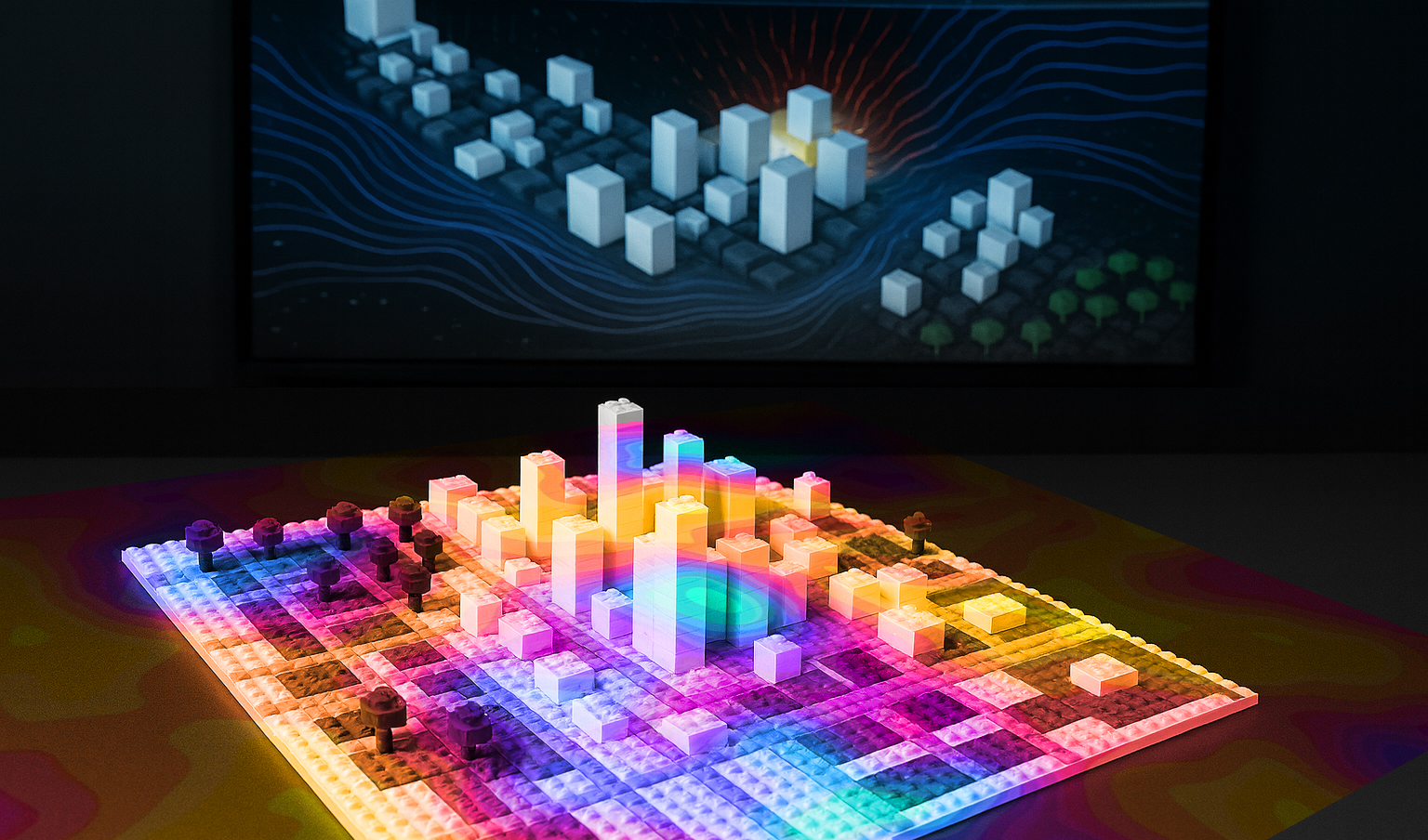
The envisioned Urban Micro-climate Sandbox would be a tangible urban climate laboratory combining CityScope-style urban modeling with ideas from Tangible Bits. Using LEGO models that replicate existing urban blocks, participants—children, residents, planners, and non-experts—can physically rearrange the city in front of them. As they stack and move bricks to change building heights, open spaces, vegetation, and water features, a future simulation would respond on an adjacent screen to illustrate how the city’s microclimate could change—both at the scale of a single hotspot and as part of a larger, connected system.

In the proposed installation, a physical LEGO model of an existing neighborhood would be linked to a digital twin. When participants raise a tower with extra bricks, the corresponding building in the virtual city grows taller, and a future simulation could recalculate airflow in street canyons and investigate its possible effects on pedestrians at ground level. Removing structures to create plazas or inserting new volumes shifts airflow across the district, changing shade patterns, surface temperature, and thermal comfort. Specialized LEGO pieces stand in for trees, water, asphalt streets, bare soil, and grass. Adding a line of street trees can lower perceived temperature and create comfortable micro-habitats; introducing vegetation or bioswales cools the air through evapotranspiration; carving out a park or paving over a courtyard alters how heat, wind, and moisture circulate.
Beyond numeric climate indicators, the proposed system would also explore ways to visualize shifts in spatial perception and emotional atmosphere—such as openness, enclosure, visibility, and a sense of safety. As the miniature city is reconfigured, the interface links physical changes in form and material to feelings of pressure, release, and psychological comfort in outdoor spaces. This combination of hands-on interaction and computational simulation draws from the lineage of Tangible Bits and the CityScope platform, enabling participants to understand urban form not only as geometry, but as a living environmental and social system.

More than a planning tool, Urban Micro-climate Sandbox is conceived as an interactive artwork: a shared device for sensing what happens when we intervene in the urban fabric, and for rehearsing alternative futures in miniature. Ultimately, it empowers communities to co-design climate-responsive cities by making microclimate knowledge public, interactive, and graspable—and by inviting people to rethink what “comfortable,” “livable,” and “desirable” urban environments could be.